
RBI UPI Kill Switch & 1-Hour Delay : What You Must Know (2026)
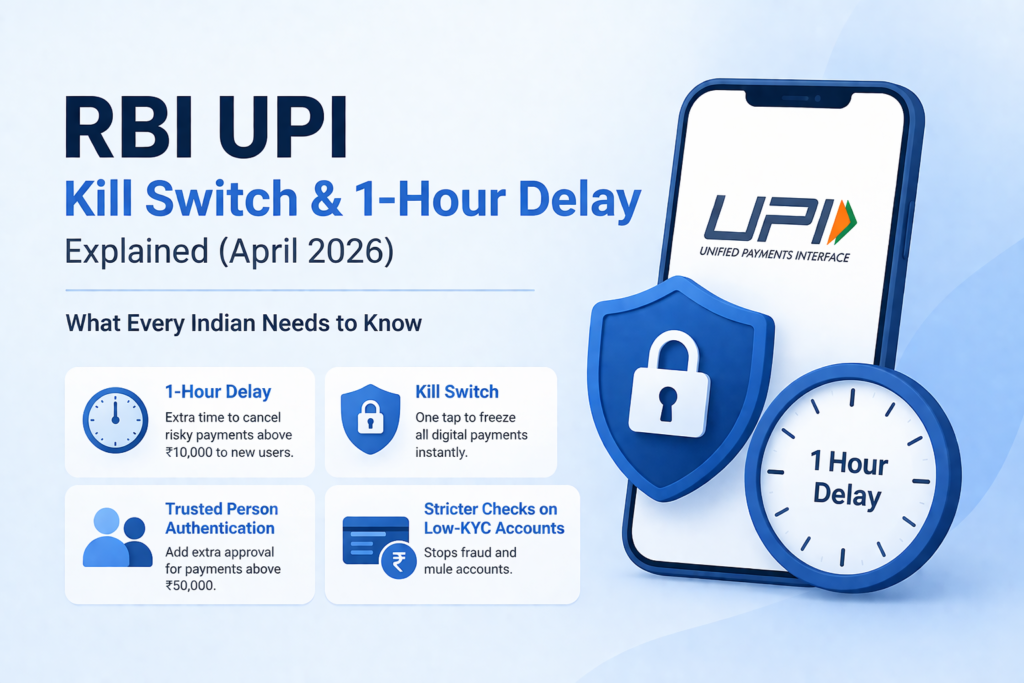
Published: April 15, 2026 | Reading Time: 8 minutes | Category: Banking & RBI Updates Quick Answer On April 9, 2026, the RBI released a discussion paper and proposed four new safeguards against digital payment fraud: (1) a 1-hour delay on transfers above ₹10,000 to new beneficiaries, (2) a universal Kill Switch to freeze all digital transactions instantly, (3) trusted-person authentication for vulnerable users on payments above ₹50,000, and (4) credit limits on low-KYC accounts. However, these are proposals — not live rules yet. Public feedback is open until May 8, 2026. Imagine this. You get a call from someone claiming to be from your bank. They sound official, and they say your account is at risk. Then, they ask you to transfer ₹15,000 immediately. Naturally, you panic. So, you open your UPI app and hit send. Under today’s rules, that money disappears within seconds. However, under the RBI’s new proposal, you would get one full hour to change your mind. This is the core idea behind the RBI’s biggest proposed change to India’s digital payment system in years. So, here is everything you need to know — in plain language. What Is the RBI Proposing? The Reserve Bank of India (RBI) released a discussion paper on April 9, 2026 titled “Exploring Safeguards in Digital Payments to Curb Frauds.” It includes four main proposals: ProposalWhat It Means for You 1-Hour Delay (Lagged Credit)Payments above ₹10,000 to a new beneficiary will wait 1 hour before reaching them Kill SwitchYou can freeze all digital payments from your account — UPI, net banking, and cards — in one action Trusted-Person AuthenticationTransactions above ₹50,000 may need approval from someone you pre-nominate (for senior citizens / people with disabilities) Low-KYC Account CapsBanks will monitor accounts with sudden large inflows more strictly to stop fraudsters from using mule accounts These are proposals, not law. Therefore, public feedback closes on May 8, 2026, and rules will come only after the RBI reviews all responses. Why Is the RBI Doing This Now? The numbers tell the story clearly. Year Fraud Cases (NCRP) Fraud Value 2021 2.6 lakh ₹551 crore 2025 28 lakh ₹22,931 crore Fraud cases rose 10 times in four years. The money lost rose 40 times. The bigger shift is how fraudsters now operate. In the past, criminals used to hack into bank systems. That has become much harder. So they switched to a simpler method — they trick you into sending the money yourself. This is called an Authorised Push Payment (APP) fraud. Common examples of UPI Fraud Once you voluntarily send the money, the bank has almost no way to recover it. The RBI’s proposals are designed to break the fraudster’s control before you press send — or give you a window to undo the damage after you do. Proposal 1: The 1-Hour Delay — Exactly How It Works This is the most discussed proposal and often misunderstood. So, let’s simplify it. When does the delay apply? When does the delay NOT apply? What happens during the 1 hour? The logic is simple. Fraudsters create urgency and panic. However, a 1-hour delay removes that pressure and gives you time to think clearly. Proposal 2: The UPI Kill Switch — Your Emergency Off Button This proposal offers immediate control in risky situations. The Kill Switch lets you disable all digital payments from your account in one step — including UPI, net banking, debit cards, and credit cards. When should you use it? How do you turn it back on? Currently, banks allow you to block services separately. However, this proposal introduces a single, universal control. Proposal 3: Trusted-Person Authentication (For Senior Citizens) This proposal focuses on protecting vulnerable users. You can nominate a trusted person. Then, for transactions above ₹50,000, that person must approve the payment. As a result, this adds a human safety layer that technology alone cannot provide. Proposal 4: Crackdown on Mule Accounts A mule account belongs to a real person but fraudsters misuse it. They move stolen money through these accounts and withdraw it quickly. To stop this, the RBI plans stricter monitoring of accounts with unusual large inflows. It may also set an annual credit limit of ₹25 lakh for low-KYC accounts. However, if you use your account normally, this will not affect you. ⚠️ Myth-Busting: What This Does NOT Mean Myth 1: “All my UPI payments will now take 1 hour.”👉 FALSE. The delay applies only to payments above ₹10,000 sent to a new beneficiary. Myth 2: “My money will be stuck every time.”👉 FALSE. Payments to saved contacts remain instant. Myth 3: “This rule is already active.”👉 FALSE. It is still a proposal. Myth 4: “Banks will block my account automatically.”👉 FALSE. You control the Kill Switch. Myth 5: “This will slow down UPI.”👉 PARTIALLY FALSE. Most daily transactions remain unaffected. How This Compares: India vs Global Standards Country Fraud Safeguard UK Banks can delay suspicious payments up to 72 hours; mandatory reimbursement for APP fraud victims Singapore 12-hour cooling-off periods for high-risk account actions; Kill Switch already deployed Australia Confirmation of Payee checks before transfers; mandatory dispute resolution India (Proposed) 1-hour delay above ₹10,000 to new payees; Kill Switch; Trusted-Person auth for vulnerable users India’s proposal is measured and proportionate. We are not going as far as the UK’s 72-hour delay. The RBI is trying to reduce fraud without killing the speed that makes UPI what it is. What Should You Do Right Now? ✅ Reader Action Checklist Most importantly, never send money under pressure. How UPI Fraud Actually Happens (Real Patterns to Know) Understanding these patterns helps you stay safe. Pattern 1 — Fake Bank OfficerThey call and ask you to verify details or send money. Pattern 2 — QR Code ScamScanning a QR code always sends money — it never receives it. Pattern 3 — Customs Fee ScamFraudsters ask for fake UPI payments for parcel delivery. Pattern 4 — Government ThreatThey create fear and demand urgent payments. In all these cases, a 1-hour delay
RBI UPI Kill Switch & 1-Hour Delay : What You Must Know (2026) Read More »