Income Tax Filling

This section is for Income tax filling queries and post

SGB Redemption April 2026 showing sovereign gold bonds, gold coins, and decision to sell or hold based on returns and tax rules

SGB Redemption April 2026: Sell or Hold for Maximum Profit ?

Quick Answer: Several SGB tranches are open for premature redemption in April 2026, with returns exceeding 200% for many investors. But whether you should exit now or hold depends entirely on how you bought your bonds. Budget 2026 changed the tax rules — and the difference between an original subscriber and a secondary market buyer is now worth lakhs. What Is Happening With SGBs Right Now? April 2026 is an unusually busy month for Sovereign Gold Bond investors. The Reserve Bank of India has opened premature redemption windows across multiple SGB tranches — and the returns on offer are staggering. The 2020-21 Series VII, for instance, had a redemption price fixed at ₹15,254 per unit. Investors who subscribed at the original issue price of ₹5,051 per unit are sitting on capital gains of over 200%. That is on top of the 2.5% annual interest paid every six months throughout the holding period. Here is a snapshot of key April 2026 SGB redemption dates confirmed by the RBI: SGB Series Premature Redemption Date 2018-19 Series II 23 April 2026 2019-20 Series V 15 April 2026 2019-20 Series VI 30 April 2026 2020-21 Series I 28 April 2026 2020-21 Series VII 20 April 2026 ⚠️ Deadline Alert: You must submit your premature redemption request through your bank, post office, NSDL, CDSL, or RBI Retail Direct portal within the official window. Missed windows cannot be reopened. The Tax Twist That Changes Everything Here is what most investors have not fully absorbed yet: Budget 2026 fundamentally changed SGB taxation from April 1, 2026. Until now, capital gains on SGB redemption were completely tax-free — no matter how you bought the bonds. That blanket exemption is gone. The new rule is simple but strict: Tax-free redemption is now available only if: That is it. Miss either condition and your gains become taxable. What This Means for Different Types of SGB Holders If you are an original subscriber holding till maturity: Nothing changes for you. Your gains at maturity remain fully exempt from capital gains tax. This is still one of the best tax deals in Indian investing. If you are an original subscriber doing premature redemption (the 5th to 7th year exit): Your gains are taxable. Premature redemption — even for original subscribers — does not qualify for the capital gains exemption. LTCG of 12.5% applies if held for more than 12 months. If you bought your SGB from a stock exchange: Your gains are now taxable regardless of how long you hold or whether you wait for maturity. The government has clearly stated the exemption applies only to original issue subscribers. Gains on redemption will attract 12.5% LTCG (if held over 12 months) or slab-rate STCG otherwise. The Real Cost of the New Tax Rule Let us put numbers to this so the impact is clear. Say you hold 100 units of an SGB. The redemption price today is ₹15,254. Your original issue price was ₹5,051. Your gain = ₹10,203 per unit × 100 = ₹10,20,300 Investor Type Tax Payable Net Gain Original subscriber, holds till 8-year maturity ₹0 ₹10,20,300 Original subscriber, premature exit ₹1,27,538 (12.5% LTCG) ₹8,92,762 Secondary market buyer, any exit ₹1,27,538 (12.5% LTCG) ₹8,92,762 The difference is not trivial. Knowing your tax situation before you hit the redemption button is critical. Should You Exit Now or Wait? There is no single answer — but here is a decision framework based on your situation. Consider exiting (premature redemption) if: Consider holding till maturity if: One more thing: No new SGB issuances have been announced for FY 2026-27. The scheme is effectively paused. If you redeem now, there is no way to reinvest back into SGBs at the same tax efficiency in the near term. How to Submit Your Redemption Request Premature redemption requests must be submitted through the institution where you hold your SGB — your bank branch, designated post office, NSDL, CDSL, or directly through RBI Retail Direct. Steps to follow: The redemption price is calculated as the simple average of the closing gold price (999 purity, IBJA-published) for the three business days preceding the redemption date. Common Questions Investors Are Asking Q: I bought SGB from Zerodha/Groww on the stock exchange in 2022. Is my maturity gain tax-free? No. The Budget 2026 rule specifically excludes secondary market buyers from the capital gains exemption. Your gains at redemption will be taxed at 12.5% LTCG (if held over 12 months). Q: What if I miss the premature redemption window? You will need to wait for the next available window (they occur every 6 months on interest payment dates) or sell on the stock exchange — though SGBs tend to be thinly traded. Q: Is the 2.5% annual interest taxable? Yes, always — regardless of whether you are an original subscriber or secondary market buyer. Interest income from SGBs is added to your total income and taxed at your applicable slab rate. Q: What is the difference between premature redemption and selling on the exchange? Premature redemption is done through the RBI window at a government-set price. Selling on the exchange means you transact at market price, which may carry a premium or discount, and brokerage charges apply. Reader Checklist Before You Act The Bottom Line SGB investors in April 2026 are sitting on exceptional returns — often 200% or more over 5-6 years. The decision to exit or hold, though, hinges on one critical factor: how you acquired your bonds, and what that now means for your tax liability. Original subscribers who can hold to maturity still have the best deal in Indian gold investing. Everyone else needs to run the numbers first. In either case, missing a redemption window or acting without knowing the tax rules could be a costly mistake. At Kapitalway we simplify complex financial decisions so you can invest with clarity and confidence. If you have any doubts about SGB redemption, tax rules, or your overall investment strategy, our experts are here to help. We offer personalized

SGB Redemption April 2026: Sell or Hold for Maximum Profit ? Read More »

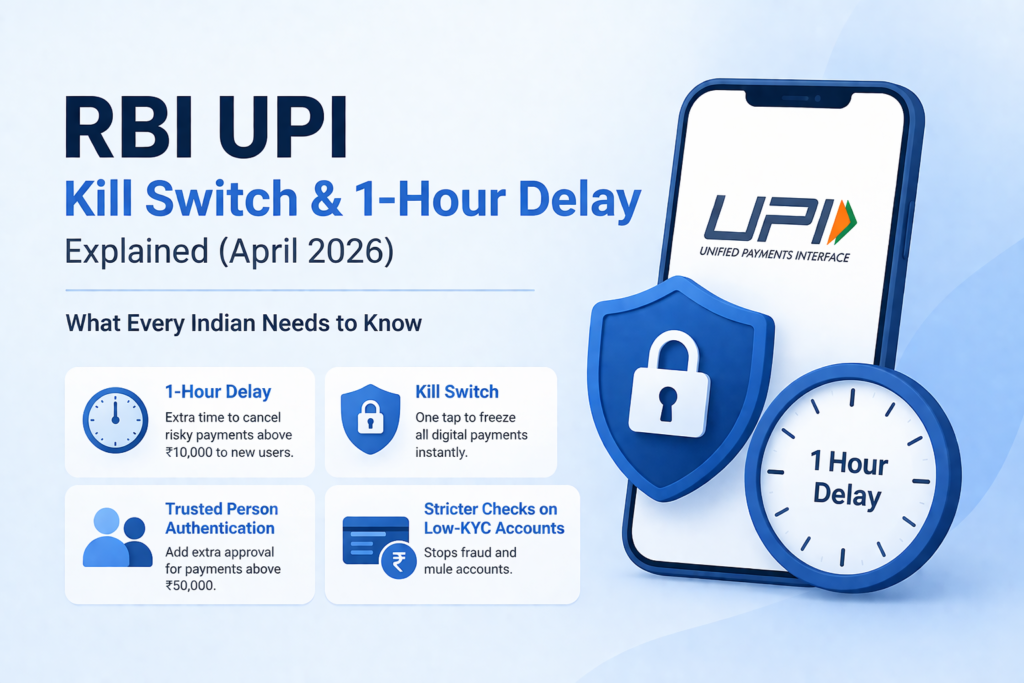
Illustration showing RBI UPI Kill Switch and 1-hour payment delay feature with mobile phone, security lock, and fraud protection elements in light blue theme

RBI UPI Kill Switch & 1-Hour Delay : What You Must Know (2026)

Published: April 15, 2026 | Reading Time: 8 minutes | Category: Banking & RBI Updates Quick Answer On April 9, 2026, the RBI released a discussion paper and proposed four new safeguards against digital payment fraud: (1) a 1-hour delay on transfers above ₹10,000 to new beneficiaries, (2) a universal Kill Switch to freeze all digital transactions instantly, (3) trusted-person authentication for vulnerable users on payments above ₹50,000, and (4) credit limits on low-KYC accounts. However, these are proposals — not live rules yet. Public feedback is open until May 8, 2026. Imagine this. You get a call from someone claiming to be from your bank. They sound official, and they say your account is at risk. Then, they ask you to transfer ₹15,000 immediately. Naturally, you panic. So, you open your UPI app and hit send. Under today’s rules, that money disappears within seconds. However, under the RBI’s new proposal, you would get one full hour to change your mind. This is the core idea behind the RBI’s biggest proposed change to India’s digital payment system in years. So, here is everything you need to know — in plain language. What Is the RBI Proposing? The Reserve Bank of India (RBI) released a discussion paper on April 9, 2026 titled “Exploring Safeguards in Digital Payments to Curb Frauds.” It includes four main proposals: ProposalWhat It Means for You 1-Hour Delay (Lagged Credit)Payments above ₹10,000 to a new beneficiary will wait 1 hour before reaching them Kill SwitchYou can freeze all digital payments from your account — UPI, net banking, and cards — in one action Trusted-Person AuthenticationTransactions above ₹50,000 may need approval from someone you pre-nominate (for senior citizens / people with disabilities) Low-KYC Account CapsBanks will monitor accounts with sudden large inflows more strictly to stop fraudsters from using mule accounts These are proposals, not law. Therefore, public feedback closes on May 8, 2026, and rules will come only after the RBI reviews all responses. Why Is the RBI Doing This Now? The numbers tell the story clearly. Year Fraud Cases (NCRP) Fraud Value 2021 2.6 lakh ₹551 crore 2025 28 lakh ₹22,931 crore Fraud cases rose 10 times in four years. The money lost rose 40 times. The bigger shift is how fraudsters now operate. In the past, criminals used to hack into bank systems. That has become much harder. So they switched to a simpler method — they trick you into sending the money yourself. This is called an Authorised Push Payment (APP) fraud. Common examples of UPI Fraud Once you voluntarily send the money, the bank has almost no way to recover it. The RBI’s proposals are designed to break the fraudster’s control before you press send — or give you a window to undo the damage after you do. Proposal 1: The 1-Hour Delay — Exactly How It Works This is the most discussed proposal and often misunderstood. So, let’s simplify it. When does the delay apply? When does the delay NOT apply? What happens during the 1 hour? The logic is simple. Fraudsters create urgency and panic. However, a 1-hour delay removes that pressure and gives you time to think clearly. Proposal 2: The UPI Kill Switch — Your Emergency Off Button This proposal offers immediate control in risky situations. The Kill Switch lets you disable all digital payments from your account in one step — including UPI, net banking, debit cards, and credit cards. When should you use it? How do you turn it back on? Currently, banks allow you to block services separately. However, this proposal introduces a single, universal control. Proposal 3: Trusted-Person Authentication (For Senior Citizens) This proposal focuses on protecting vulnerable users. You can nominate a trusted person. Then, for transactions above ₹50,000, that person must approve the payment. As a result, this adds a human safety layer that technology alone cannot provide. Proposal 4: Crackdown on Mule Accounts A mule account belongs to a real person but fraudsters misuse it. They move stolen money through these accounts and withdraw it quickly. To stop this, the RBI plans stricter monitoring of accounts with unusual large inflows. It may also set an annual credit limit of ₹25 lakh for low-KYC accounts. However, if you use your account normally, this will not affect you. ⚠️ Myth-Busting: What This Does NOT Mean Myth 1: “All my UPI payments will now take 1 hour.”👉 FALSE. The delay applies only to payments above ₹10,000 sent to a new beneficiary. Myth 2: “My money will be stuck every time.”👉 FALSE. Payments to saved contacts remain instant. Myth 3: “This rule is already active.”👉 FALSE. It is still a proposal. Myth 4: “Banks will block my account automatically.”👉 FALSE. You control the Kill Switch. Myth 5: “This will slow down UPI.”👉 PARTIALLY FALSE. Most daily transactions remain unaffected. How This Compares: India vs Global Standards Country Fraud Safeguard UK Banks can delay suspicious payments up to 72 hours; mandatory reimbursement for APP fraud victims Singapore 12-hour cooling-off periods for high-risk account actions; Kill Switch already deployed Australia Confirmation of Payee checks before transfers; mandatory dispute resolution India (Proposed) 1-hour delay above ₹10,000 to new payees; Kill Switch; Trusted-Person auth for vulnerable users India’s proposal is measured and proportionate. We are not going as far as the UK’s 72-hour delay. The RBI is trying to reduce fraud without killing the speed that makes UPI what it is. What Should You Do Right Now? ✅ Reader Action Checklist Most importantly, never send money under pressure. How UPI Fraud Actually Happens (Real Patterns to Know) Understanding these patterns helps you stay safe. Pattern 1 — Fake Bank OfficerThey call and ask you to verify details or send money. Pattern 2 — QR Code ScamScanning a QR code always sends money — it never receives it. Pattern 3 — Customs Fee ScamFraudsters ask for fake UPI payments for parcel delivery. Pattern 4 — Government ThreatThey create fear and demand urgent payments. In all these cases, a 1-hour delay

RBI UPI Kill Switch & 1-Hour Delay : What You Must Know (2026) Read More »

new income tax rules 2026

New Income Tax Act 2025: What Actually Changed?

April 1, 2026 | KapitalWay | 8 min read The new financial year has officially begun — and this time, it brings a historic shift in India’s tax system. For the first time in 64 years, the country is operating under a completely new income tax law. Earlier, the Income Tax Act 1961 governed taxation in India. However, with the introduction of the Income Tax Act 2025 — passed in August 2025 — the old framework has now been fully replaced, not merely amended. At first glance, this may sound like a major overhaul. But in reality, for most salaried individuals, very little has changed in terms of actual tax outflow. Tax slabs remain the same, deductions continue as before, and even the filing process is largely unchanged. In fact, the government has described this transition as a “revenue-neutral” reform. Simply put, the rules haven’t drastically changed — they’ve just been rewritten in a clearer and more structured way. That said, a few important updates are worth understanding. So, let’s walk through them step by step — without confusion or unnecessary jargon. What Exactly Is the New Income Tax Act 2025? Over the decades, India’s tax system evolved through numerous amendments. As a result, the earlier law became lengthy, complex, and often difficult to interpret. Multiple cross-references and outdated provisions further added to the confusion. To address this, the Income Tax Act 2025 has been introduced with 552 sections, spread across 23 chapters and 16 schedules. The primary aim is to simplify compliance, modernize the system, and reduce legal disputes. In other words, while the structure has been refreshed, the core principles remain largely unchanged — much like renovating a house without altering its foundation. Change #1 — Goodbye “Assessment Year,” Hello “Tax Year” One of the most noticeable changes is the removal of the dual-year system. Previously, taxpayers had to deal with: Because of this, many individuals found tax filing confusing. Now, the new law introduces a single term — “Tax Year.” This makes things far more straightforward. For instance, income earned between April 2026 and March 2027 will simply be referred to as Tax Year 2026–27. However, it’s important to note that income earned between April 2025 and March 2026 will still be filed under the old system (AY 2026–27). The new terminology applies only from April 2026 onward. Change #2 — Tax Slabs and ₹12 Lakh Benefit Remain Unchanged Naturally, this is the biggest concern for most taxpayers. Fortunately, there is no change here. The existing tax structure continues as it is. The slab rates also remain unchanged: That said, one important detail often gets overlooked. The ₹12 lakh benefit does not apply to special-rate income such as: Therefore, if you’ve invested in stocks or mutual funds, reviewing your tax calculation becomes essential. Change #3 — HRA Rules: Stricter Yet More Beneficial For those claiming HRA, this update brings a mix of stricter rules and added benefits. On one hand, taxpayers are now required to disclose their relationship with the landlord. This step is aimed at reducing false claims. Consequently, cases involving close family members may face additional scrutiny. On the other hand, the rules have become more favourable for certain cities. The 50% HRA exemption now applies to: Earlier, only the first four cities were eligible. As a result, taxpayers in newly added cities can now claim higher exemptions. To stay compliant: Change #4 — Increased Allowances for Children Another welcome update comes in the form of higher allowances. Previously, these limits were extremely low and outdated. Now, they offer meaningful relief, especially for middle-class families managing rising education costs. Change #5 — Higher Medical Loan Exemption Healthcare expenses can be financially stressful. Keeping this in mind, the exemption on employer-provided medical loans has been significantly increased. As a result, employees receiving medical support from their employers can benefit from improved tax efficiency. Change #6 — Increased STT for F&O Traders If you actively trade in futures and options, this update directly impacts you. The Securities Transaction Tax (STT) has been increased, which means higher transaction costs. While traders will feel the impact, long-term investors remain unaffected. Change #7 — Updated Rules for Sovereign Gold Bonds There’s also a notable change in how Sovereign Gold Bonds (SGBs) are taxed. Now, tax exemption on redemption applies only to original subscribers. In contrast, investors who purchase SGBs from the secondary market will have to pay capital gains tax. Therefore, if you fall into the latter category, planning your investment timeline becomes important. Change #8 — Credit Card Spending Now Reported High-value transactions are now under clearer monitoring. From April 1, 2026: …will be reported to the tax department. Additionally, PAN is now mandatory for all new credit card applications. Although scrutiny of large transactions isn’t new, the reporting thresholds are now more structured and transparent. Change #9 — Partial Extension of ITR Deadlines Some filing deadlines have been relaxed, but not for everyone. Since most salaried individuals file ITR-1 or ITR-2, their deadline remains unchanged. Change #10 — Lower TCS on Overseas Spending Finally, there’s some relief for international transactions. This means less upfront deduction and improved cash flow. Common Myths You Should Ignore Myth 1: 80C has been removedIn reality, it still exists — only its placement within the law has changed. Myth 2: Tax Year 2026–27 includes earlier incomeThis is incorrect. It applies only to income earned from April 2026 onward. Myth 3: Filing process has changed completelyOn the contrary, the filing process remains exactly the same. Quick Comparison: What Changed vs What Didn’t Changed Unchanged What Should You Do This Week? To stay on track, consider taking these steps: If you’re unsure how these updates apply to your situation, that’s exactly where KapitalWay can help. Reach out to us or explore our detailed guides for better clarity.✔️ File ITR as usual — no changes required 👉 Most importantly: Don’t panic. Nothing drastic has changed for salaried taxpayers. FAQs Q1: Is the Income Tax Act

New Income Tax Act 2025: What Actually Changed? Read More »

tax harvesting strategy India 2026

Last-Minute Tax Harvesting Guide for : FY 2025-26

Tax Harvesting Before March 31: Save Capital Gains Tax in the Last Few Days (FY 2025-26) If you invest in stocks or mutual funds, the next few days could save you thousands of rupees in taxes — legally, without any tricks. March 31, 2026 is the last day of the current financial year (FY 2025-26). And if you haven’t looked at your portfolio yet, you still have time to use one of the most powerful — and most underused — tax strategies available to Indian investors: Tax Harvesting. In this guide, we break it down simply, step by step. What Is Tax Harvesting? Tax harvesting is a strategy where you sell selected investments before March 31 to either: It does not mean exiting your investments permanently. In most cases, you sell and immediately reinvest — so your portfolio stays the same, but your tax bill goes down. Think of it this way: You are not changing your investment plan. You are just being smart about when you book gains or losses on paper. Why March 31 Matters So Much Any tax activity you do must fall within the same financial year to count. FY 2025-26 ends on March 31, 2026 — after which it’s gone. But here’s the catch: don’t wait until March 31 itself. Stock settlements in India follow a T+1 cycle. This means if you place a sell order on March 31, it may settle on April 1 — which falls in the next financial year and gives you zero benefit this year. ✅ Safe deadline: Place your trades by March 28, 2026 (which is today!) to be absolutely safe. Capital Gains Tax Rates in India — FY 2025-26 Before you act, you need to know what you’re dealing with: Type Holding Period Tax Rate Short-Term Capital Gains (STCG) Less than 12 months 20% Long-Term Capital Gains (LTCG) More than 12 months 12.5% (above ₹1.25 lakh) LTCG up to ₹1.25 lakh More than 12 months 0% (Tax-Free!) These rates apply to listed equity shares and equity mutual funds where STT has been paid. 📌 Important: These rates apply whether you are in the Old Tax Regime or the New Tax Regime. Capital gains tax is the same for everyone. Two Types of Tax Harvesting — Which One Do You Need? 1. Tax-Gain Harvesting (Use Your Free ₹1.25 Lakh Limit) Who it’s for: Investors who have long-term gains in their portfolio Every financial year, the first ₹1.25 lakh of Long-Term Capital Gains (LTCG) from equity shares and equity mutual funds is completely tax-free under Section 112A. If you don’t use this limit before March 31, it lapses forever — you cannot carry it forward to next year. How it works: The Result: You legally pocket up to ₹1.25 lakh of profit — tax-free. And by reinvesting, your cost price resets higher, which means lower tax in the future. 💡 Maximum tax you can save this way: ₹15,625 (12.5% of ₹1.25 lakh). Doesn’t sound huge, but done every year for 15 years, that’s over ₹2.3 lakh saved — plus compounding on top. 2. Tax-Loss Harvesting (Use Your Losses to Kill Your Tax Bill) Who it’s for: Investors who have taxable gains AND some investments currently in the red If some of your investments are sitting at a loss, you can sell them to offset your gains — and reduce the tax you owe on profits elsewhere. Example — How it works in real life: Your Gains Amount Tax Due LTCG from Nifty Fund (above ₹1.25L) ₹1,25,000 ₹15,625 STCG from Mid-cap Stock ₹60,000 ₹12,000 Total Tax Due ₹27,625 Now you sell two underperforming positions: Your Losses Booked Amount IT Sector Fund (Long-term loss) ₹80,000 Small-cap Stock B (Short-term loss) ₹40,000 After applying these losses, your tax bill drops significantly — potentially to near zero. The Rules of Loss Set-Off — Don’t Get This Wrong Not all losses can cancel all gains. Here’s the exact rule: 🔑 Bonus Rule for FY 2025-26: There is a one-time relief this year — Long-Term Capital Losses booked before March 31, 2026 can be set off against STCG in AY 2027-28. This is a rare, time-limited opportunity. 💼 REAL CLIENT STORY Still not sure how this works in real life? Here’s how we helped one of our clients turn a market panic into a double win — discounted entry + a tax shield for 8 years. [Read More..] Step-by-Step: How to Do Tax Harvesting Today Step 1 — Pull your capital gains report Log in to your broker or mutual fund platform. Download the P&L or Capital Gains Report for FY 2025-26. Look for both realised and unrealised gains/losses. Step 2 — Identify your situation Are you in profit (use gain harvesting) or do you have mixed gains and losses (use loss harvesting)? Or both? Step 3 — Do the math Calculate your total LTCG. If it’s below ₹1.25 lakh, you’re already safe. If above, check how much loss you can book to bring it down. Factor in brokerage and STT costs — only act if the tax saving is greater than transaction costs. Step 4 — Execute before the deadline Place your sell orders today (March 28) for stocks. For mutual funds, place redemption requests well within the cut-off time to ensure same-day NAV. Step 5 — Reinvest smartly You can reinvest in the same fund or stock immediately. India has no wash-sale rule — selling and buying back is completely legal. Just be aware of the small market risk during the gap period. Step 6 — File your ITR on time This is non-negotiable. If you want to carry forward unused losses (up to 8 years), you must file your Income Tax Return before the due date (usually July 31). Miss it and you lose the carry-forward benefit permanently. When Should You NOT Do Tax Harvesting? Tax harvesting is not always the right move. Skip it if: Always ask: Am I saving tax or losing returns? The answer should clearly be the former.

Last-Minute Tax Harvesting Guide for : FY 2025-26 Read More »

I’m in the New Tax Regime — Where Should I Invest Now?

Published by KapitalWay | March 2026 | Reading Time: 7 minutes You’ve moved to the new tax regime. Your salary is now taxed at lower slab rates, your TDS has reduced, and your monthly take-home salary has increased. That’s the positive side. But here’s the question that’s confusing thousands of salaried individuals across India right now: “If I no longer get deductions under 80C or 80D, why should I still invest in ELSS, PPF, or LIC? And where should I actually invest my money now?” This guide answers exactly that. The reality is simple — losing tax deductions doesn’t mean you should stop investing. It simply means your investments now need to be smarter and more goal-driven. First, Let’s Understand What Actually Changed Under the old tax regime, taxpayers received deductions for investing in certain financial products: Under the new tax regime, most of these deductions are no longer available. However, the trade-off is lower income tax slab rates, which means a larger portion of your income stays with you every month. The biggest shift in thinking is this: Earlier: You invested mainly to save tax.Now: You invest primarily to build wealth. And honestly, that’s a healthier and more sustainable approach to managing money. Where Should You Invest Under the New Tax Regime? 1. 📈 Mutual Funds via SIP — Your #1 Wealth-Building Tool Investment , Mutual funds ,SIP Without the mandatory 3-year lock-in of ELSS, you now have the flexibility to choose mutual funds purely based on your financial goals and risk tolerance — not tax benefits. But here’s what really makes mutual funds compelling. Compare the long-term returns across popular instruments: Instrument Approx. Returns Taxability PPF 7.1% p.a. Tax-free LIC Endowment 4–5% p.a. Tax-free Nifty 50 Index Fund (15yr avg) 13–14% p.a. LTCG at 12.5% above ₹1.25L Flexi Cap Funds (15yr avg) 14–16% p.a. LTCG at 12.5% above ₹1.25L Past returns are not a guarantee of future performance. Mutual fund investments are subject to market risk. Even after paying LTCG tax, equity mutual funds have historically delivered significantly higher wealth creation than traditional tax-saving instruments over a 10–15 year horizon. Goal Recommended Fund Type Long-term wealth (10+ years) Large Cap / Flexi Cap / Index Funds Aggressive growth Mid Cap / Small Cap Funds Balanced investing Hybrid / Balanced Advantage Funds Short-term parking (1–3 years) Liquid / Short Duration Debt Funds Why SIP works even better now: 🔖 KapitalWay Real Story: Priya Ma’am had been putting ₹5,000/month into ELSS for years — purely for the tax deduction. When the new regime arrived, we helped her redirect that money more effectively. [Read her full story →] 2. 🏠 National Pension System (NPS) — Still Worth Considering Many investors don’t realise this, butNPS still provides a tax advantage even under the new regime. Under Section 80CCD(2), contributions made by your employer to your NPS account remain tax-exempt, even if you choose the new tax regime. Real Example: Rahul earns a basic salary of ₹50,000/month. His employer contributes 10% (₹5,000/month) to his NPS under Section 80CCD(2). That’s ₹60,000/year that never gets added to his taxable income — and he didn’t invest a single extra rupee. His HR team simply restructured his CTC. What you should do Apart from tax benefits, NPS is also a low-cost retirement investment with equity exposure, making it a strong long-term retirement planning too. 3. 🏦 Build an Emergency Fund First Before investing in markets, ensure you have 3–6 months of expenses saved in an easily accessible emergency fund. Where to keep your emergency fund Since the new tax regime increases your monthly take-home, it becomes a great opportunity to build or strengthen this safety cushion first. 4. 💊 Health Insurance — No Longer a Tax Tool, But Essential Earlier, many people bought health insurance mainly to claim the 80D deduction. Now that the deduction is not available under the new regime, some individuals question whether it’s still necessary. The answer is simple: Yes — it’s more important than ever. Medical inflation in India is currently around 14% annually. A single hospitalisation can easily cost ₹3–10 lakh or more, which can severely impact your savings. Recommended coverage Health insurance should be viewed as wealth protection, not a tax-saving instrument. 5. 📊 Direct Equity — For Experienced Investors If you have a higher risk tolerance and a long investment horizon (7+ years), direct stock investing can be a powerful wealth-building option. Under the new tax regime, Long Term Capital Gains (LTCG) on equity exceeding ₹1.25 lakh per year are taxed at 12.5%, which is still relatively favorable compared to many other asset classes. Best approach for beginners 6. 🪙 Gold — 10–15% Portfolio Allocation Gold has historically acted as a hedge against inflation and economic uncertainty. Without tax incentives pushing investors toward certain instruments, gold deserves a balanced place in a diversified portfolio. Best ways to invest in gold today Sovereign Gold Bonds (SGBs)Issued by RBI, they provide 2.5% annual interest plus gold price appreciation, and the maturity proceeds are tax-free after 8 years. Gold ETFs / Gold Mutual FundsEasy to buy and sell through the market, with no storage or purity concerns. Avoid buying physical gold purely for investment, as making charges, storage costs, and purity risks reduce overall returns. 7. 🏡 Real Estate — Only If It Fits Your Life Goals Real estate continues to be a popular investment in India, but it should be treated as a life decision rather than a tax-saving strategy, especially since home loan tax deductions are largely unavailable under the new regime. Consider property investment if: Avoid buying property simply because “real estate always goes up.” In many Indian cities, rental yields are only 2–3%, which barely beats inflation. Additionally, property is far less liquid than financial assets like mutual funds or stocks. How to Build Your Portfolio Under the New Tax Regime A simple allocation model based on a moderate risk profile: Asset Class Allocation Purpose Equity Mutual Funds (SIP) 50–60% Long-term wealth creation NPS (Employer Contribution) 10%

I’m in the New Tax Regime — Where Should I Invest Now? Read More »

ITR Filing with GST Turnover : A Detailed Guide

For businesses registered under GST, filing the income tax return (ITR) can be a complex process if you are unsure how to handle GST turnover calculation for income tax. Proper reporting of turnover is essential not only for compliance but also to ensure that your taxable income is computed correctly. In this guide, we walk you through the ITR filing process for GST dealers, offering practical advice on documentation, turnover calculations, accounting adjustments, and common pitfalls to avoid. Understanding GST Turnover and Its Impact on ITR Filing What Is GST Turnover and Why Does It Matter? GST turnover is essentially the total value of all taxable supplies, exempt supplies, exports, and inter-state supplies that your business makes during a financial year. However, it’s important to note that not every element of this turnover is considered while filing your GST business income tax return. Knowing which parts are applicable and which are not is crucial to accurately computing your taxable income and avoiding errors in reporting. GST Turnover vs Taxable Income: Clearing the Confusion A common misunderstanding among business owners is equating GST turnover with taxable income. While turnover represents your gross sales or total supply value, taxable income is what remains after you deduct legitimate expenses, depreciation, and adjust for input tax credits (ITC). Accurate taxable income calculation from GST turnover ensures that you neither overstate nor understate your liability, helping you stay compliant and avoid penalties. How GST Registration Influences Tax Reporting Requirements Being a GST-registered business comes with specific obligations. One of the most important things is reporting your turnover correctly while filing your ITR. Depending on the nature of your business and accounting practices, you will need to select the appropriate ITR form for GST registered business—commonly ITR-3 for businesses maintaining full accounting records or ITR-4 for those opting for presumptive taxation. Incorrect reporting can lead to scrutiny, tax audits, or fines, so careful preparation is key. Dispelling Common Misconceptions About GST Turnover Reporting Documents You Need for ITR Filing with GST Turnover GST Returns and Statements For a thorough and error-free income tax return GST business filing, you should collect copies of all relevant GST returns, such as GSTR-1, GSTR-3B, and annual filings. These documents form the backbone of your reporting and help reconcile turnover figures. Financial Records Including Bank Statements Accurate reporting requires a well-maintained financial trail. Gather your bank statements, ledgers, cash flow reports, and other records to cross-check and support the turnover and expense claims in your return. Organizing Invoices for Purchases and Sales A systematic approach to organizing your invoices simplifies the process of how to file ITR online GST. Well-maintained invoices ensure that your purchase and sales data can be uploaded efficiently, reducing the chances of mistakes and omissions during submission. How to Calculate Taxable Income from GST Turnover Converting Turnover Into Taxable Income Start by reviewing your total GST turnover. From this, subtract non-taxable sales, exemptions, and allowable business expenses to arrive at the net business income eligible for taxation. Claiming Legitimate Deductions Only expenses that are properly documented and incurred wholly for business purposes should be claimed while preparing your ITR filing with GST turnover. Unsupported expense claims can invite audits and penalties. Adjusting for Input Tax Credit (ITC) Properly managing and adjusting input tax credits is critical in ensuring that your taxable income is computed without discrepancies. Inaccurate adjustments can result in compliance issues during your GST compliance ITR filing. Accounting Methods: Cash vs Accrual Your accounting method—whether cash-based or accrual-based—can affect how you recognize income and expenses. Depending on your method, adjustments may be required to reconcile timing differences and reflect the correct taxable income. Choosing the Right ITR Form for GST-Registered Businesses Filing ITR-3 for Detailed Accounting If you maintain detailed books of accounts, including ledgers and supporting documentation, ITR-3 is the ideal choice. It allows you to report business income comprehensively and claim eligible deductions. Filing ITR-4 Under the Presumptive Taxation Scheme Small businesses or self-employed individuals with simpler financial records can opt for ITR-4. This form allows you to declare income based on a predetermined percentage of your turnover, simplifying compliance while ensuring tax obligations are met. How to Decide Between Presumptive Taxation and Regular Accounting Businesses with lower turnovers and fewer transactions may benefit from presumptive taxation due to its ease and reduced paperwork. On the other hand, larger businesses with more complex financial activities should use detailed accounting methods to ensure accuracy in GST turnover calculation for income tax. A Step-by-Step Guide on How to File ITR Online GST Accessing the Income Tax E-Filing Portal To begin the ITR filing process for GST dealers, log into the official income tax portal using your valid credentials. Verify your account to access the forms and submission tools required. Entering GST Turnover Details Correctly Before submitting, cross-check your turnover figures against GST filings to ensure accuracy. Errors in reporting can result in unnecessary scrutiny and potential penalties. Uploading Supporting Documents Prepare your financial documents—balance sheets, invoices, and bank statements—in the prescribed format and upload them during the filing process. Well-organized files make the submission process smoother and more efficient. Verification and Final Submission Once all details are entered, review the information carefully. Sign digitally where required and submit your return before the deadline to avoid late fees or other compliance issues. Common Errors to Avoid During ITR Filing with GST Turnover Misreporting Turnover Figures Errors in reporting GST turnover can trigger audits and reassessment notices. Always reconcile turnover figures with your GST returns before submitting the final ITR. Incorrect Claims for Expenses Avoid claiming expenses that are not supported by proper documentation. Only genuine, verifiable expenses should be included to prevent tax complications. Missing Disclosures and Schedules Incomplete forms or missing schedules can result in rejection or delays in processing your income tax return or GST business filing. Post-Filing Compliance and Maintaining Records Keeping Accurate Books of Accounts Consistent bookkeeping practices ensure that future GST compliance ITR filings are smooth and error-free, helping you

ITR Filing with GST Turnover : A Detailed Guide Read More »

GST 2.0: What the New Tax Reforms Mean for You, MSMEs, and India’s Growth

India’s biggest tax reform since 2017 is here — and it’s going to impact your monthly budget, business costs, and even the way the economy grows. The GST Council has approved GST 2.0, a simplified two-slab structure with 5% and 18% tax rates (plus a 40% slab for luxury and sin goods), effective September 22, 2025. So, what does this really mean for you and for millions of small businesses? Let’s break it down. What’s Changing Under GST 2.0? Until now, GST had four slabs — 5%, 12%, 18%, and 28%. This often created confusion, duty inversion (where inputs were taxed higher than finished goods), and a heavy compliance burden. From September 22: This shift simplifies taxation and makes GST easier for both consumers and businesses. Cheaper Essentials for Consumers Your grocery bill and household expenses are set to come down. Key reductions include: In short, from your kitchen shelf to your living room electronics, many items will now cost less. Relief in Health, Education & Insurance One of the biggest wins for households is in insurance: This is a major step to make protection and healthcare affordable and increase insurance coverage across India. Families will save significantly on premiums. Boost for Farmers & MSMEs The GST 2.0 changes aren’t just about consumers — they also aim to empower MSMEs and farmers: This means lower costs for small manufacturers and artisans, encouraging local production and exports. MSMEs, in particular, benefit from simplified slabs and reduced compliance headaches. Policy Perspective: Why the Big Change? The government’s key goals with GST 2.0 are: It’s not just a rate cut — it’s a structural reform to make India’s indirect tax regime next-gen and growth-oriented. What Gets Costlier? While most essentials are cheaper, some categories are moving up: This helps balance revenue loss from essential cuts while targeting high-end consumption. Final Takeaway For households, GST 2.0 means lower costs on food, medicines, appliances, insurance, and more. For MSMEs, it brings simpler slabs, cheaper inputs, and less compliance stress. And for India’s economy, it sets the stage for higher consumption, greater insurance penetration, and stronger MSME growth. cheaper essentials + empowered small businesses + simplified compliance = stronger India.

GST 2.0: What the New Tax Reforms Mean for You, MSMEs, and India’s Growth Read More »

What to Do If You Receive an Income Tax Notice for Political Donation Deduction (80G vs 80GGC)

What to Do If You Receive an Income Tax Notice for Political Donation Deduction (80G vs 80GGC)

If you recently made a claim of deduction of donation to a political party and received a notice from the Income Tax Department, don’t worry, you are not alone. Numerous taxpayers unknowingly claim such deductions under an incorrect section and then receive tax demands. Difference Between Section 80G and 80GGC/80GGBLet’s Connect Political donations should always be claimed under 80GGC/80GGB, not 80G Why Did You Get a Tax Notice for 80G Deduction? • Incorrect section claimed – You claimed under 80G rather than 80GGC/80GGB.• Cash donation – Not deductible.• Unregistered political party – Donations will be accepted only when the party is registered under Section 29A ofthe Representation of People Act, 1951.• Mismatch in disclosures – Party’s election returns do not correspond with your claim. How to Deal with Income Tax Notice for Political Donation Deduction Step 1: Identify the Type of Notice 143(1)(a) Intimation – Automated adjustment, disallowance of deduction.143(2)/148 Notice – Scrutiny or reassessment. Step 2: Check Your Donation Evidence Maintain bank transfer receipt / cheque / digital payment document. Verifythe political party is registered under Section 29A. Step 3: If Your Claim is Correct Respond online with proof of donation. Attach party registration information ifpresent. Step 4: If Your Claim is Wrong Accept departmental adjustment. Pay extra tax + interest (under Section 234B &234C) via Challan 280. Amend your response in the e-proceedings section of the Income Tax Portal. Here To help!

What to Do If You Receive an Income Tax Notice for Political Donation Deduction (80G vs 80GGC) Read More »

ITR Notice

How to File Your ITR if You Have Salary Income + Amazon Affiliate Income

If you have a full-time job and make an additional income from Amazon affiliate marketing, you might wonder: Which ITR form to use? How do I report this income? Don’t panic; most salaried individuals these days have a side job, and the Income Tax Department has well-defined guidelines for it. Let’s discuss step by step. Salary + Amazon Affiliate Income – Which ITR Form to Use? Let’s Connect Quick Tip: If your affiliate income is minimal and you’re not interested in maintaining records, opt for ITR-4.If your affiliate income is large and you wish to display actual profit after deducting expenses, use ITR-3. Documents You’ll Need Before submitting, collect these: Step-by-Step Process to File ITR Type in affiliate income:– In ITR-3 → type receipts and expenses– In ITR-4 → type gross receipts; 50% will be considered as profit. Things to Keep in Mind   Final Thoughts If you’re an employed professional earning from Amazon affiliate marketing, you don’t have to file your ITR that hard. Select ITR-4 for a straightforward process under presumptive taxation. Select ITR-3 if you wish to claim business expenses and reflect precise profits. Filing within a timely manner keeps you in compliance, saves you penalties, and makes your financial record clean for the future.   If you’re looking for expert advice on navigating market volatility and making smart investment decisions, feel free to contact us Here To help!

How to File Your ITR if You Have Salary Income + Amazon Affiliate Income Read More »

Scroll to Top