ELSS vs Flexi Cap New Tax Regime India Mutual Fund Investment SIP Investment Financial Planning India

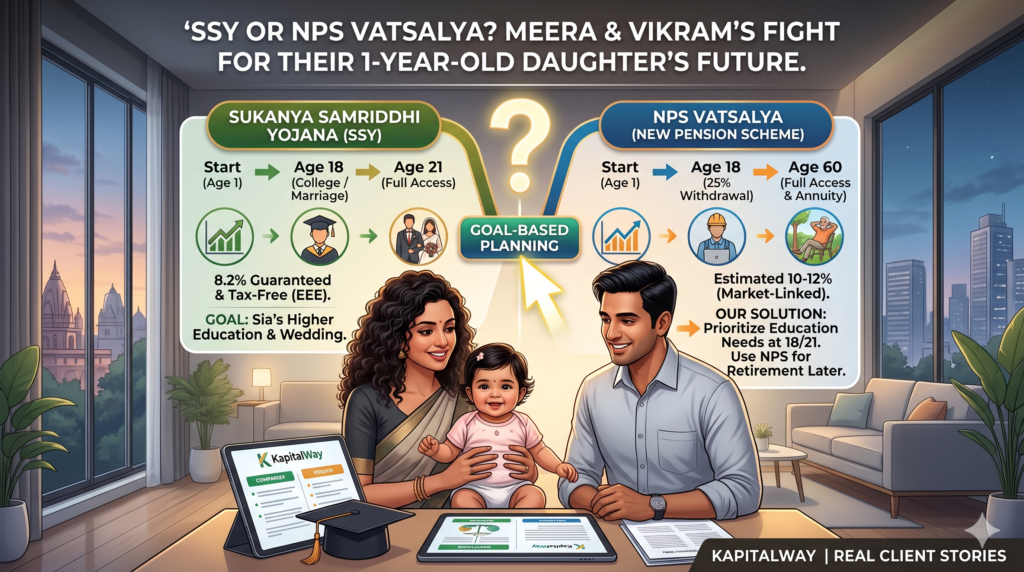
Indian parents with their baby girl comparing Sukanya Samriddhi Yojana (SSY) and NPS Vatsalya investment plans.

Ek Daughter, Do Schemes, Ek Confusion

Ek Daughter, Do Schemes, Ek Confusion — KapitalWay Her Daughter Was Just 1 Year Old — But Her Parents Had Been Fighting Over This Investment Decision for 3 Months A real story from our client files — the question every new parent in India is asking, and exactly how we helped them settle it 👤 CLIENT Meera & Vikram T. Name Changed Meera — Talent Acquisition Expert Vikram — IT Professional Kanpur Meera and Vikram had been married for three years. Their daughter Sia had just turned one. Between them, they bring home a combined income of ₹78,000 a month. They had a PPF account, a small LIC endowment policy, and a recurring deposit running at the post office. Financially, they were cautious, careful people — the kind who read before they sign. When Sia was born, they promised themselves they would start something specifically for her — something that would still be standing when she needed it most. But they couldn’t agree on what. ⚠️ THE SITUATION Meera had heard about Sukanya Samriddhi Yojana from a colleague at work. The returns sounded solid — government-backed, safe, fixed interest, and the account was specifically for girl children. It felt personal. It felt right. Vikram had a different view. He had read about NPS Vatsalya after it launched in late 2024. “10 to 12% returns, no upper limit on investment, market-linked growth” — to him, SSY at 8.2% sounded like they were leaving money on the table. For three months, they went back and forth. Neither was wrong — but neither had the complete picture. When they finally came to us, Meera opened the conversation. “Hum dono ki baat hi nahi ban rahi. Woh kehte hain NPS Vatsalya better hai. Main kehti hun SSY safe hai. Sia ke liye kya sahi hai — yeh sirf aap hi bata sakte hain.” — Meera’s first words to us at our initial meeting 💡 OUR SOLUTION 1 Goal pehle, scheme baad mein — what does Sia actually need this money for? Before we touched any numbers, we asked one question: When do you need this money, and for what? Their answer was immediate — Sia’s college education, and if needed, her wedding. Not her retirement at 60. That single answer changed the entire conversation. NPS Vatsalya is a pension scheme. The bulk of the corpus it builds stays locked until the child is 60 years old. For parents saving for a daughter’s college at age 18 or 21, that is the wrong tool for the job — no matter how good the headline return looks. 2 Show them the withdrawal reality — not just the corpus number This is where Vikram’s assumption broke down. We put both schemes on paper with the same investment — ₹60,000 per year — starting from when Sia is 1 year old. Sukanya Samriddhi (SSY) NPS Vatsalya Estimated corpus at age 18 ~₹25.8 lakh ~₹30.4 lakh Withdrawal allowed at 18 50% for education 25% for education/illness Usable money at age 18 ~₹12.9 lakh ✅ ~₹7.6 lakh Full access At age 21 At age 60 Tax on maturity Zero — fully EEE ✅ 40% annuity is taxable NPS Vatsalya builds a bigger total number. But SSY puts more actual rupees in Sia’s hands at 18 when she needs them for college — and the full amount by 21. Vikram stared at the table for a long time. “Yeh toh maine kabhi socha hi nahi tha,” he said quietly. 3 Resolve the tax confusion — the ₹50,000 deduction doesn’t need Sia’s account Vikram’s other reason for NPS Vatsalya was the extra ₹50,000 deduction under Section 80CCD(1B). What he didn’t know is that this deduction can be claimed on his own NPS account — which he already had through his IT employer. He did not need to open NPS Vatsalya for Sia to unlock that benefit. Topping up his own NPS by ₹50,000 this year was all it took. Two birds, one stone. 4 Open SSY immediately — every month of delay costs compounding SSY can only be opened for a girl child below 10 years of age. Sia was 1. Every month they delayed was one less month of compounding at 8.2% — guaranteed and fully tax-free. We helped Meera open the account at their nearest authorised bank branch the same week. The first deposit of ₹12,500 went in immediately. Going forward, they plan to deposit ₹1.5 lakh per year — the maximum — to make Sia’s corpus as full as possible. 5 Keep NPS Vatsalya as a future option — not a pressure decision today We did not tell Vikram to forget NPS Vatsalya forever. If in two or three years their income grows and they want to add a second layer of long-term wealth for Sia — one she manages herself after turning 18 — NPS Vatsalya can still be opened then. She will still be under 18. The door stays open. But today, with one goal (education) and one daughter, SSY was the clear first move. ⏳ WHERE WE STAND NOW The confusion has been resolved. Sia has her Sukanya Samriddhi account. Vikram has topped up his own NPS to claim the extra ₹50,000 deduction. The family has a clean, clear plan — and nobody is arguing anymore. ✅ Done — SSY Account Opened Sia’s account is active, first deposit made, passbook in Meera’s hand ✅ Done — Tax Plan Fixed Vikram’s own NPS topped up — ₹50,000 extra deduction claimed without locking Sia’s money till 60 ✅ Done — Annual Investment Plan Set ₹1.5 lakh/year into SSY locked in; NPS Vatsalya revisit planned when income grows ⏳ In Progress — Sia’s Corpus Growing 20 years of compounding ahead — we will be watching every step “Pehle lagta tha ki yeh decision bahut complicated hai. Lekin jab humne samjha ki Sia ke liye paise kab chahiye aur kitne chahiye — sab clear ho gaya. Ab main aur Vikram dono ek page par hain. Aur Sia ka future

Ek Daughter, Do Schemes, Ek Confusion Read More »
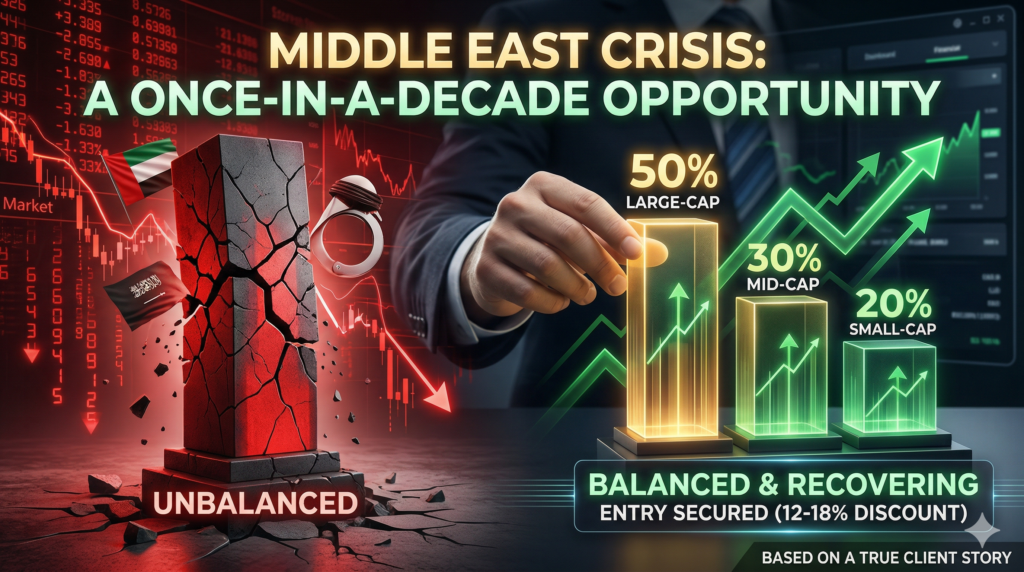
A real client story by Kapitalway showing how a Middle East market crisis was turned into a tax harvesting and portfolio rebalancing opportunity for a salaried investor in Gurugram

Market Crisis to Portfolio Opportunity

He Was Sitting on a Solid Portfolio — But a Middle East Crisis Turned It Into a Once-in-a-Decade Opportunity A real story from our client files — what the market threw at him, and exactly how we turned it into a double win 👤 Client Arjun S. Name Changed Manager, Leading Telecom Company Gurugram Arjun had been investing consistently for 4 years. A manager at one of India’s leading telecom companies, he had a stable monthly income and had been channelling a portion into mutual funds. After Nifty’s strong bull run in the previous year, he had gradually shifted the majority of his portfolio into large-cap mutual funds — the “safe, steady” choice. His portfolio was diversified enough on paper, but the heavy tilt toward large-caps left little room to capture upside if markets corrected. ⚠️ The Situation In March 2026, geopolitical tensions in the Middle East escalated sharply. Global markets reacted swiftly — oil prices spiked, foreign institutional investors began pulling out, and Indian markets saw a broad-based selloff. Large-cap stocks and mutual funds — which form the core of most Indian portfolios — fell steeply within days. Arjun called us in a panic. His portfolio was down ₹1.9 lakh in unrealised value. On the surface, it looked like a bad month. But when we looked deeper, we saw something most investors miss during a crisis — this wasn’t just a loss. It was a rare, time-sensitive opportunity wrapped in fear. “Yaar, sab kuch red ho gaya hai. Main kya karun? Kya nikal lun sab? Bahut dara hua hun abhi.” — Arjun’s first message to us at 9:20 AM on a Monday morning. 💡 Our Solution 1 Calm first, strategy second — assess before acting Our first move was to stop Arjun from panic-selling. We pulled up his complete portfolio and separated unrealised losses from actual damage. His diversified structure had actually protected him — the fall was contained. We explained: the market didn’t break your portfolio. It just opened a door. 2 Book Short-Term Capital Losses — before March 31 We identified his large-cap fund positions that were sitting at a short-term loss. We strategically redeemed these units before March 31 — locking in the Short-Term Capital Loss (STCL) officially on paper. This loss can now be carried forward for up to 8 assessment years, ready to offset any future capital gains when he withdraws in profit. 3 Reinvest immediately into Small & Mid Cap at discounted prices India has no wash-sale rule — you can sell and reinvest immediately. We used the redeemed amount to enter quality small-cap and mid-cap mutual funds that had corrected 12–18% from their recent highs. Arjun was buying at prices not seen in over a year — using the same money, with a much higher growth runway ahead. 4 Rebalance the overall portfolio — fix the large-cap overweight We used this moment to correct what was always the underlying issue: too much concentration in large caps. Post-rebalancing, Arjun’s portfolio had a healthy split — 50% large-cap, 30% mid-cap, 20% small-cap — better positioned for the next phase of the market cycle regardless of when geopolitical tensions ease. 5 File ITR on time to preserve the carry-forward benefit We reminded Arjun that the capital loss carry-forward only works if he files his Income Tax Return before the due date. We connected him with our CA partner to ensure this was not missed — because losing the carry-forward due to a late filing would have wiped out half the benefit. ⏳ Where We Stand Now The strategy has been fully executed. Arjun’s portfolio has been rebalanced, the capital losses are officially booked before March 31, and fresh positions in small & mid-cap funds are now in place — entered at prices not seen in over a year. The market recovery is still playing out, and we are watching closely. But here’s what we already know for certain today: ✅ Done — Entry Secured Small & mid-cap entered at 12–18% below recent highs ✅ Done — Portfolio Fixed Large-cap overweight corrected to a balanced allocation ⏳ In Progress — Market Recovery Returns on new positions still unfolding — we’re watching Pehle bahut dara hua tha. Lekin jab team ne explain kiya ki yeh loss nahi, ek opportunity hai — tab samajh aaya. Ab portfolio bhi better lag raha hai aur future mein tax ka bhi ek strong backup mil gaya hai. Ab bas market ka wait kar rahe hain! — Arjun S., Manager, Leading Telecom Company, Gurugram (March 2026) 📌 We will share the final outcome once the 3-month mark is reached. Follow Kapitalway to see how this story ends — because the best part is still coming. A real story from Kapitalway — names changed to protect client privacy. Not financial advice.

Market Crisis to Portfolio Opportunity Read More »

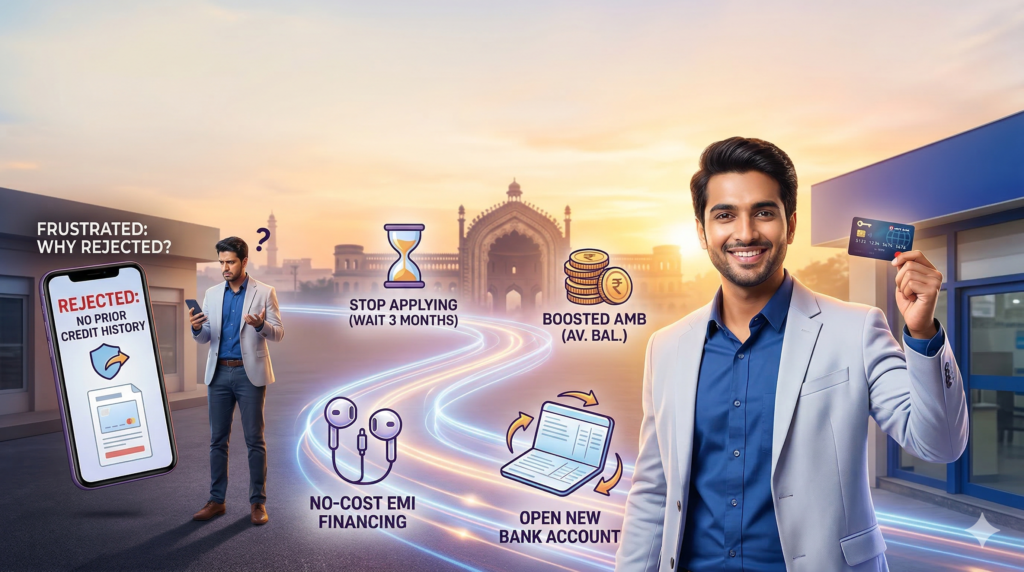
A salaried professional in India got rejected for his first credit card despite having a good salary and stable job

Why He Got Rejected for His First Credit Card ?

He Had a Good Salary, a Stable Job — and Still Got Rejected for His First Credit Card A real story from our client files — what went wrong, and exactly how we fixed it. 👤 Client Rahul Name Changed — Salaried Professional, Lucknow 🔴 Problem Faced Rahul came to us wanting his very first credit card. On paper, he was the ideal applicant — salaried, well-educated, working at a reputed company with a decent monthly income. He had never missed a payment or defaulted on anything in his life, simply because he had never borrowed anything. Looking for an easy route, he applied for the HDFC Neu credit card through the Tata Neu app, assuming the process would be simple. A few taps, basic details, and submit. The rejection came back fast. Reason: no prior credit history. His salary account was with a different bank, so HDFC had no existing relationship with him — no transaction data, no AMB history, nothing to evaluate him on. Clean finances, zero credit trail — and a rejection anyway. He came to us frustrated: “Main koi galat kaam nahi kiya — toh reject kyun hua?” (I haven’t done anything wrong — so why was I rejected?) That is the painful Catch-22 of credit for first-timers in India: you need credit history to get a credit card, but you need a credit card to build that history. 💡 Our Solution We started not with a card recommendation — but by explaining exactly why the rejection happened and what the bank’s system was actually looking for. Once he understood that, the path forward became clear. 1 Stop applying immediately — wait at least 3 months. Every rejected application leaves a hard inquiry on your CIBIL report. Multiple inquiries in a short window make lenders more cautious, not less. Applying again immediately would only make his situation worse. 2 Build credit history using Bajaj Finserv No-Cost EMI. We asked him to buy any electronic product he already needed and convert the purchase into a Bajaj No-Cost EMI. Zero interest, no hidden charges. Bajaj reports every on-time payment to CIBIL — so each month he paid his EMI, his credit score grew from zero. No credit card or formal loan required. 3 Boost Average Monthly Balance (AMB) — do this alongside Step 2. We asked him to park a lump sum in his savings account and leave it untouched for the 3 months. Banks check AMB when evaluating applications. A healthy balance signals financial stability — especially when your salary account is not with the target bank. Both steps needed to happen together. 4 Open an account at HDFC — his target bank. Since he wanted an HDFC card, we suggested he open an HDFC savings account and run regular transactions through it. Banks extend pre-approved credit card offers to customers with active account histories. Becoming their customer first would make his next application far warmer from the bank’s perspective. 5 Credit card against FD — the backup option. We also explained this route: near-guaranteed approval, no credit history required. But we were honest about the trade-off — the FD amount stays blocked as collateral, and secured cards offer far fewer rewards compared to standard annual-fee cards. Use this only if a card is urgently needed, not as the primary strategy. ✅ Outcome Rahul followed Steps 2 and 3 together. He bought a pair of earphones on Bajaj No-Cost EMI, parked his savings in his account for the 3-month period, and opened an HDFC savings account on the side to start building that banking relationship. Three months later, he applied again — this time with an active EMI account, a clean repayment record, a healthy Average Monthly Balance, and an HDFC account to his name. He got the card. “Pehle lagta tha bank ne mujhe reject kiya — ab samajh aaya ki process samjha nahi tha. Aapne seedha bataya, toh ho gaya.” (Earlier I thought the bank rejected me. Now I understand I didn’t know the process. You explained it clearly — and it worked.) The outcome we are most proud of is not just the card — it is the fact that Rahul now understands how the credit system actually works. A rejection is not a verdict on your financial worth. It is a data gap. Give the system the right information, through the right channels, over the right amount of time — and the outcome changes.

Why He Got Rejected for His First Credit Card ? Read More »

Confident Indian female teacher in Lucknow smiling while reviewing a growing investment portfolio on her laptop.

From Tax-Saving to Future-Building: Priya vs. the Market

👤 Client Priya Ma’am — Government School Teacher, Lucknow 🔴 The Problem Priya Ma’am had been investing ₹5,000 every month in ELSS funds for years—primarily to claim deductions under Section 80C. However, when her school shifted her to the new tax regime, that benefit disappeared overnight. She came to us confused and anxious, asking a very honest question:“Ab ELSS mein kyun invest karun? Agar tax benefit hi nahi hai, toh iska fayda kya hai?” But beneath this question was a deeper concern she had never expressed before—the fear of losing money in the market. As long as ELSS helped her save tax, she was comfortable taking that risk. But once the tax advantage was gone, the risk felt real—and intimidating. No one had ever explained market risk to her in a simple, honest way. That clarity was missing—until she came to KapitalWay. 💡 Our Approach We didn’t start by recommending a new product.We started by addressing her fear. First, we reviewed her own ELSS investment history and showed her something important—her money had grown over time, not declined. Then we explained what market risk truly means for a long-term SIP investor:Short-term fluctuations are normal, but historically, disciplined investors in India have seen positive outcomes over longer periods like 7+ years. Once she understood this, we introduced a simple comparison between ELSS and a Flexi Cap fund. She realised that a Flexi Cap fund offered: No lock-in period Greater flexibility Diversification across India and global markets Easy access to funds during emergencies And the benefit of ₹1.25 lakh annual LTCG exemption Importantly, we did not change her SIP amount.She continued investing ₹5,000 per month—just in a more suitable direction. No pressure. No complexity. Just a decision she fully understood and felt confident about. ✅ The Outcome Priya Ma’am has now been investing in a Flexi Cap fund for over a year, and her portfolio is performing well. But the real success is not just in the returns—it’s in her mindset. In the beginning, she would often message us during market dips:“Sir, ghabrana chahiye kya?” Over time, those messages stopped. Not because she stopped caring—but because she finally understood the difference between short-term market movements and long-term growth. Recently, she shared something that truly reflects her transformation: “Pehle tax bachane ke liye invest karti thi. Ab future banane ke liye karti hoon. Aur ab market girne par darr nahi lagta—kyunki ab samajh hai.” (Earlier, I invested to save tax. Now I invest to build my future. And even when the market falls, I don’t feel scared—because now I understand.) ✨ Final Thought This is what truly matters.Not just better investments—but better understanding. Because when fear is replaced with clarity,investing stops feeling risky… and starts feeling empowering.

From Tax-Saving to Future-Building: Priya vs. the Market Read More »

Scroll to Top