
He Had a Stable Job, a Good Salary — and Still Got Rejected for His First Credit Card. Here’s What We Told Him.
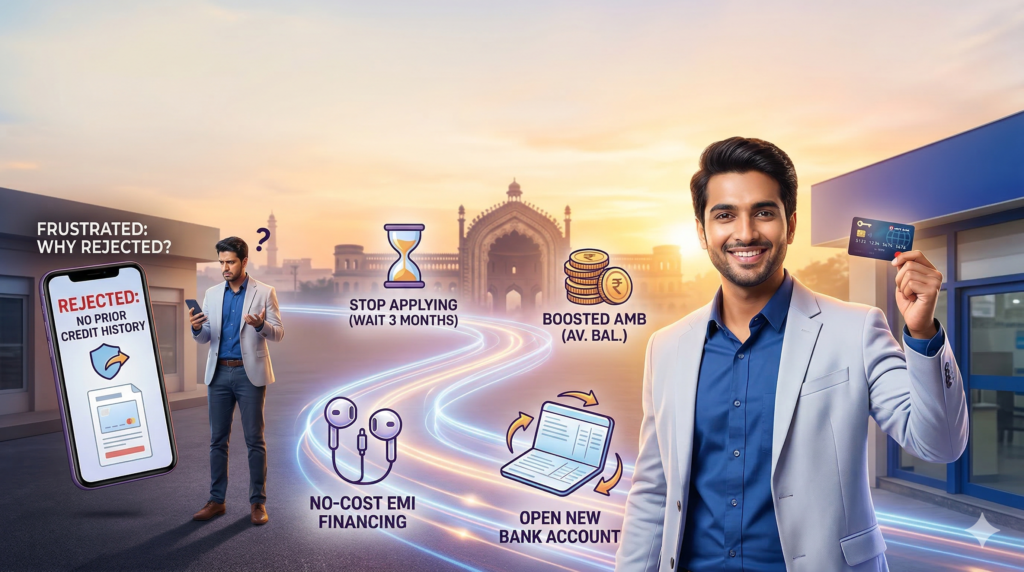
👤 Client Rahul Name Changed — Salaried Professional, Lucknow 🔴 Problem Faced Rahul came to us wanting his very first credit card. On paper, he was the ideal applicant — salaried, well-educated, working at a reputed company with a decent monthly income. He had never missed a payment or defaulted on anything in his life, simply because he had never borrowed anything. Looking for an easy route, he applied for the HDFC Neu credit card through the Tata Neu app, assuming the process would be simple. A few taps, basic details, and submit. The rejection came back fast. Reason: no prior credit history. His salary account was with a different bank, so HDFC had no existing relationship with him — no transaction data, no AMB history, nothing to evaluate him on. Clean finances, zero credit trail — and a rejection anyway. He came to us frustrated: “Main koi galat kaam nahi kiya — toh reject kyun hua?” (I haven’t done anything wrong — so why was I rejected?) That is the painful Catch-22 of credit for first-timers in India: you need credit history to get a credit card, but you need a credit card to build that history. 💡 Our Solution We started not with a card recommendation — but by explaining exactly why the rejection happened and what the bank’s system was actually looking for. Once he understood that, the path forward became clear. 1 Stop applying immediately — wait at least 3 months. Every rejected application leaves a hard inquiry on your CIBIL report. Multiple inquiries in a short window make lenders more cautious, not less. Applying again immediately would only make his situation worse. 2 Build credit history using Bajaj Finserv No-Cost EMI. We asked him to buy any electronic product he already needed and convert the purchase into a Bajaj No-Cost EMI. Zero interest, no hidden charges. Bajaj reports every on-time payment to CIBIL — so each month he paid his EMI, his credit score grew from zero. No credit card or formal loan required. 3 Boost Average Monthly Balance (AMB) — do this alongside Step 2. We asked him to park a lump sum in his savings account and leave it untouched for the 3 months. Banks check AMB when evaluating applications. A healthy balance signals financial stability — especially when your salary account is not with the target bank. Both steps needed to happen together. 4 Open an account at HDFC — his target bank. Since he wanted an HDFC card, we suggested he open an HDFC savings account and run regular transactions through it. Banks extend pre-approved credit card offers to customers with active account histories. Becoming their customer first would make his next application far warmer from the bank’s perspective. 5 Credit card against FD — the backup option. We also explained this route: near-guaranteed approval, no credit history required. But we were honest about the trade-off — the FD amount stays blocked as collateral, and secured cards offer far fewer rewards compared to standard annual-fee cards. Use this only if a card is urgently needed, not as the primary strategy. ✅ Outcome Rahul followed Steps 2 and 3 together. He bought a pair of earphones on Bajaj No-Cost EMI, parked his savings in his account for the 3-month period, and opened an HDFC savings account on the side to start building that banking relationship. Three months later, he applied again — this time with an active EMI account, a clean repayment record, a healthy Average Monthly Balance, and an HDFC account to his name. He got the card. “Pehle lagta tha bank ne mujhe reject kiya — ab samajh aaya ki process samjha nahi tha. Aapne seedha bataya, toh ho gaya.” (Earlier I thought the bank rejected me. Now I understand I didn’t know the process. You explained it clearly — and it worked.) The outcome we are most proud of is not just the card — it is the fact that Rahul now understands how the credit system actually works. A rejection is not a verdict on your financial worth. It is a data gap. Give the system the right information, through the right channels, over the right amount of time — and the outcome changes.